
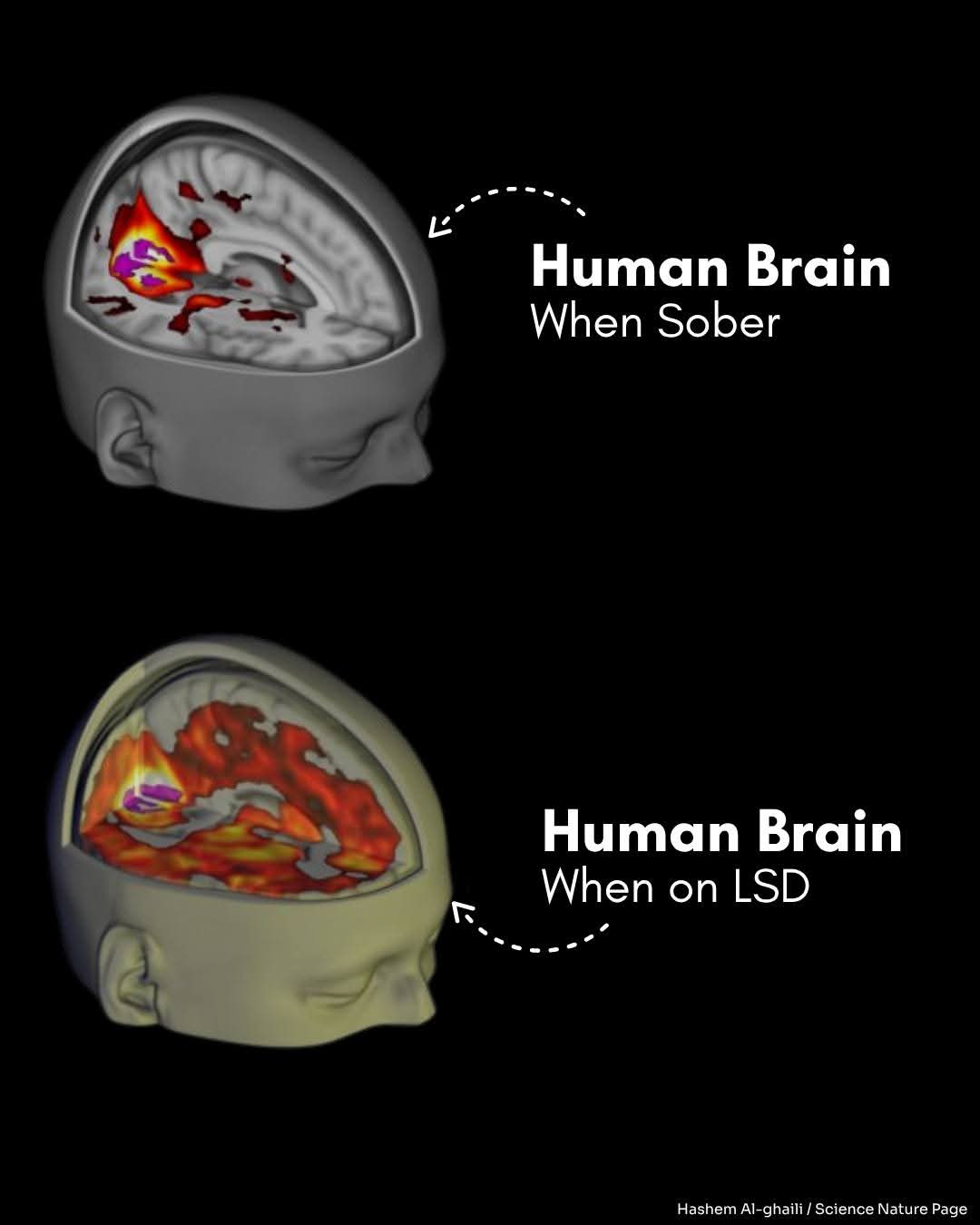
Scientists captured the world’s first brain scans of individuals on LSD, revealing how the psychedelic substance fundamentally alters neural connectivity to produce both hallucinations and unified consciousness.
For the first time, researchers from Imperial College London, in partnership with the Beckley Foundation, have mapped the profound effects of LSD on the human brain using advanced fMRI and MEG imaging.
By administering the drug to 20 healthy volunteers, scientists observed that LSD breaks down the brain's typical compartmentalization. Instead of functioning in segregated modules, the brain under LSD operates as a highly integrated and unified network.
This dramatic shift in neural organization helps explain the intense emotional responses, altered sense of self, and deep shifts in consciousness associated with the psychedelic experience.
A key discovery from the study revealed that even with their eyes closed, participants experienced vivid, dreamlike visual hallucinations driven by heightened communication between the visual cortex and memory-processing regions like the parahippocampus. This sensory activation was further intensified when paired with music, suggesting that combining psychedelics with sound could serve as a powerful therapeutic tool. By disrupting entrenched, rigid neural pathways, researchers believe LSD could revolutionize clinical treatments for mental health conditions such as treatment-resistant depression and addiction, potentially rewriting how we approach brain therapy.
source: Carhart-Harris, R. L., Muthukumaraswamy, S., Roseman, L., Kaelen, M., Droog, W., Murphy, K., … & Nutt, D. J. Neural correlates of the LSD experience revealed by multimodal neuroimaging. Proceedings of the National Academy of Sciences, 113(17), 4853-4858.
Credit: Hashem Al-Gaili