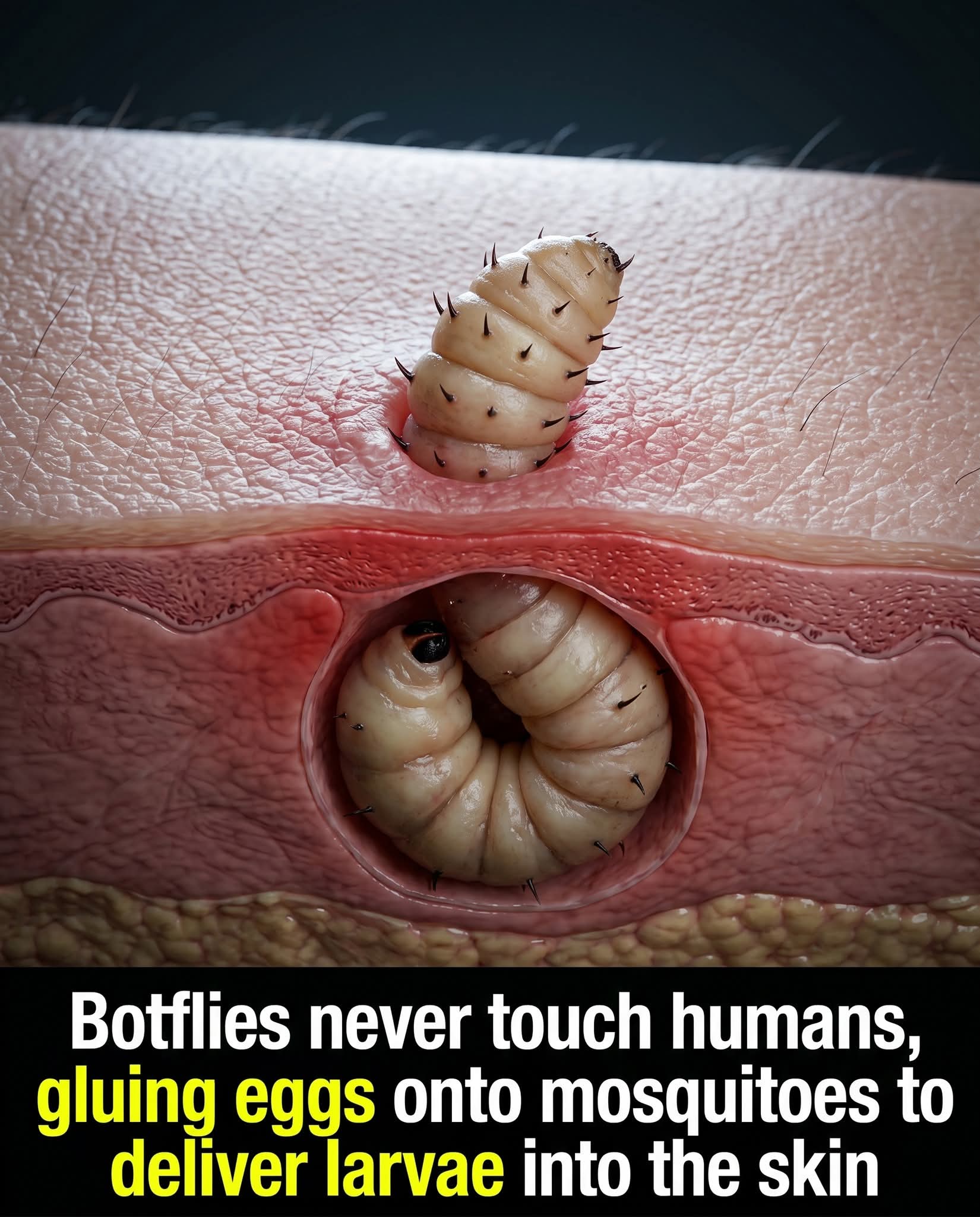

The Human Botfly never lands on humans directly. The female captures a mosquito mid-flight and glues her eggs to its abdomen using a fast-setting biological adhesive. When that mosquito lands on warm human skin, the body heat triggers the eggs to hatch in seconds, and the larvae burrow through the skin using cutting mouthparts before the host feels anything. Once beneath the skin, the larva excavates a pocket in the subcutaneous tissue and maintains a small breathing hole at the skin surface through which it presses its respiratory spiracles. Backward-facing spines cover its body and grip the surrounding tissue so effectively that pulling the larva out directly risks tearing it apart inside the wound, causing dangerous infection. The larva feeds on tissue secretions rather than blood and causes a characteristic sensation of movement under the skin every few days as it repositions. It develops for 6 to 12 weeks before enlarging its breathing hole and emerging to fall to the ground and pupate. The most effective removal method is covering the breathing hole with petroleum jelly to deprive it of oxygen; this forces the larva to protrude from the hole for air, allowing it to be safely extracted with forceps.
Source: Science Spark