

Tesla and BYD are two of the world's leading electric vehicle (EV) manufacturers, each with a powerful global presence but very different approaches and market valuations.
While both are shaping the future of electric mobility, they operate on different scales and business models.
Tesla: The High-Flying Innovator
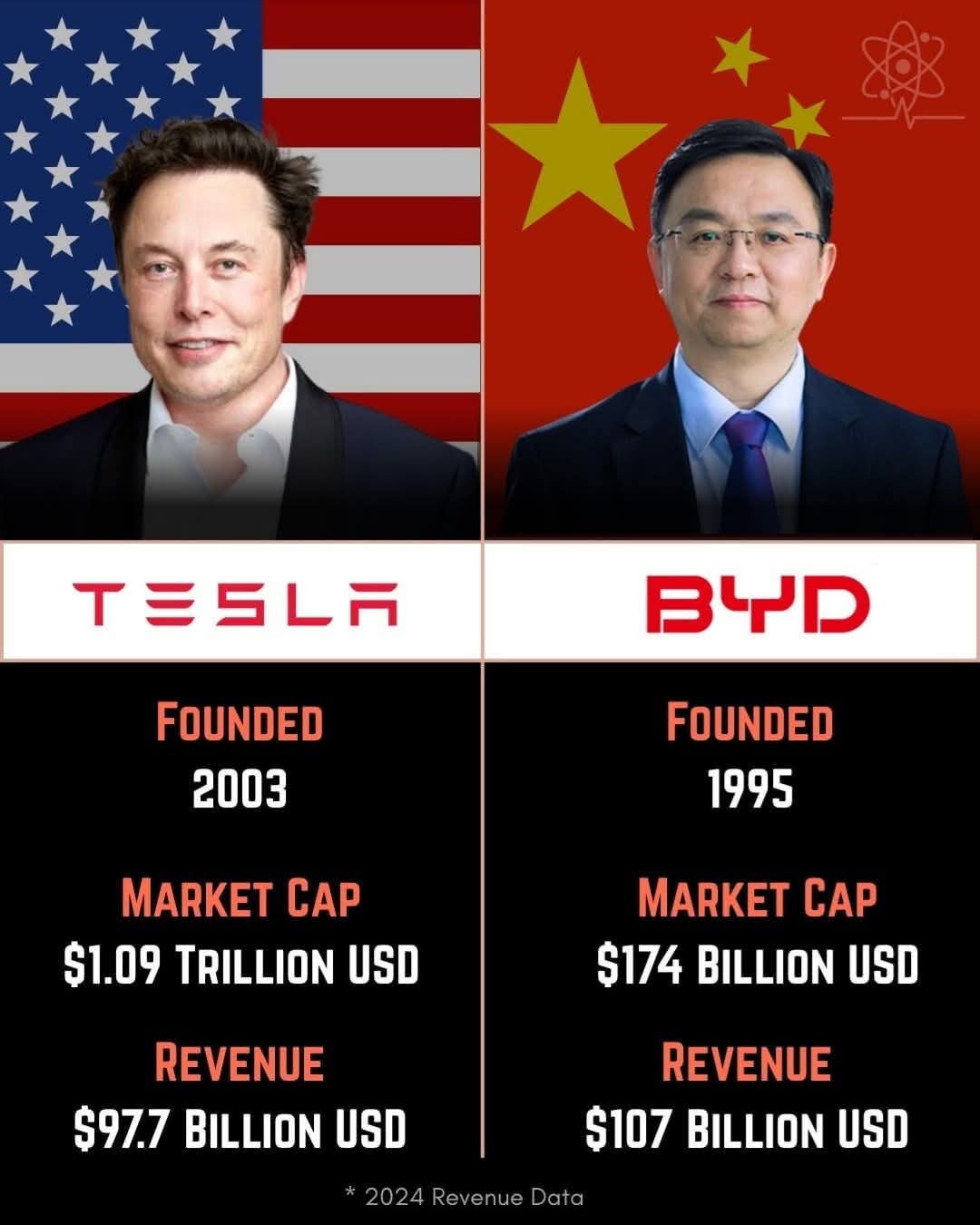
Founded in the U.S. and helmed by Elon Musk, Tesla is known for its soaring valuation and strong brand recognition. With a market cap of over $1 trillion in mid-2024, Tesla's value reflects its status as more than just a car company—it's also a leader in autonomous driving, battery technology, and software services.
While its 2024 revenue of $97.7 billion was slightly less than BYD's, Tesla consistently achieves higher profit margins, signaling strong investor confidence and high growth expectations.
Tesla's influence is particularly strong in North America and Europe.
BYD: The Vertically Integrated Powerhouse
BYD, a Chinese company, has become the world’s largest EV manufacturer by unit sales, surpassing Tesla in deliveries multiple times.
Its business model is based on vertical integration, meaning it produces key components like batteries and semiconductors in-house, which helps control costs and production. With a 2024 revenue of about $107 billion and a market cap of $174 billion, BYD's valuation is significantly lower than Tesla's despite generating more revenue.
This difference is largely due to Tesla's "tech company" appeal and high-growth potential in the eyes of investors. BYD's reach is dominant in Asia and Latin America, with a growing presence in Europe.
A Clash of Giants
The rivalry between Tesla and BYD highlights a fascinating dynamic: the battle between a premium tech-focused company and a vertically integrated, high-volume manufacturer.
Tesla's brand and innovation drive its immense value, while BYD's strategy of in-house production and broad market presence powers its high unit sales.
This competition not only shapes the EV industry but also reflects larger shifts in the global economy and industrial power.
Source: Science pulse